Digital Draft Measurement
AI and image processing for automated draft measurement
A vessel’s draft is dynamic and depends on many factors. This is why seagoing vessels are physically measured in many ports. The process is labor-intensive and time-consuming. Technolution’s Digital Draft Measurement system performs the same task using cameras and artificial intelligence—automatically, accurately, and quickly.
A vessel’s captain leaves a port in China. While analyzing the weather forecast, the captain already estimates the vessel’s expected draft upon arrival at the port of Amsterdam. Why is this necessary?
Most importantly, the vessel must not touch the bottom. Port access channels have strict depth restrictions. If a vessel sits too deep in the water, it risks running aground, sustaining structural damage, and incurring serious delays. Carrying less cargo to reduce the draft, however, is economically undesirable.
But can the draft not simply be calculated from the cargo weight? Unfortunately, it cannot. The amount of fuel and water on board also affects the vessel’s draft. Its speed plays a role as well. A physical measurement in the port remains essential. Traditionally, an operator circles the large seagoing vessel in a small boat and manually reads the draft marks on its hull. Could this process be automated?
With Digital Draft Measurement (DDM), we developed an automated system that combines AI models, conventional computer vision, and hardware control. The following sections explain how the technology works.
The technology behind DDM: an advanced processing chain
Pan-tilt-zoom cameras with high-quality zoom lenses are installed on both sides of the channel. An advanced software chain controls the camera motors and converts raw measurement data into useful information.
Step 1: Determining the vessel’s position
The first step is to determine the vessel’s exact position and identify its bow and stern. The vessel enters the measurement area at a steady, controlled speed. An operator indicates that the vessel has been selected for measurement.
Step 2: Locating the draft marks and measuring speed
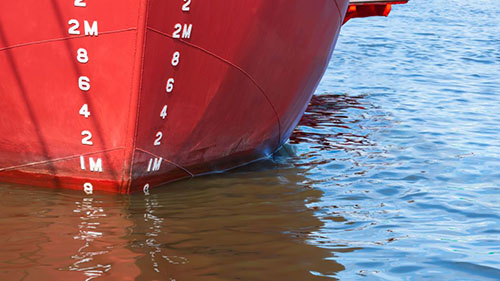
The system then searches for the draft marks on the sides of the vessel. Large seagoing vessels have six marks in total: at the bow, amidships, and at the stern, on both sides of the vessel. We use a fine-tuned YOLO model—You Only Look Once—to locate these draft marks in real time. At the same time, the algorithm calculates the vessel’s exact speed using optical flow analysis. By quantifying the movement of pixels over time, the system determines precisely how fast the vessel is moving.
Step 3: Zooming in and tracking
Once we know the vessel’s speed and the positions of the draft marks, we zoom in as far as possible to read the numbers beside them. During this process, each camera must follow the vessel’s movement accurately. This is one of the most challenging parts of the algorithm. The system operates in a real-time control loop. It controls the camera motors to track the vessel, captures high-resolution images, and runs AI models for image processing—all at the same time.
Step 4: Combining the data
At this stage, the system has identified the decimeter marks—the numbers 2, 4, 6, and 8 at 20-centimeter intervals—and the meter indicators. In practice, these markings are often difficult to read because of rust, algae, mechanical damage, or reflections. To make the AI model more robust under these conditions, during the training phase we artificially add rust and motion blur to the training data. The system then combines a sequence of images over time using statistical filters. This removes occasional measurement errors and produces a reliable overall trend.
Step 5: Identifying the waterline
Finally, we use another AI model to identify the waterline: the horizontal line where the water meets the vessel. Reflections in the water make this line difficult to segment using conventional techniques. We therefore labeled hundreds of images by hand. The AI model trained with these images now determines the point where the draft mark intersects the waterline with a high degree of accuracy.
Reliable results for the port of the future
The system now has all the required information. It locates the draft marks at six positions, reads them to within a few centimeters, and determines exactly where they meet the water. This requires a carefully coordinated chain of processing steps. Together, these steps produce a reliable measurement of the vessel’s draft.
We summarize the measurement results in a report for the operator. In exceptional situations, the system may be uncertain about a result. When this happens, the algorithm flags the uncertainty immediately. The recorded images then enable the operator to review the images and make the right decision quickly.
Digital Draft Measurement demonstrates how AI, embedded hardware, and smart software engineering can solve a practical challenge in port operations. Automated measurements from the shore improve safety for port personnel, help vessels move through the port more efficiently, and make port operations less vulnerable to shortages of qualified technicians and port professionals.