Intelligent bus priority through smart software for legacy roadside systems
The Netherlands has had priority systems for public transport for many years. Buses could automatically influence traffic lights as far back as the 1970s. Today, many municipalities have systems such as KAR (Korte Afstand Radio; short-range devices) and iTLCs to give priority to trams and buses. Could these existing roadside systems also be used for further innovations? In Scandinavia, Technolution is working on innovative systems that implement public transport priority in a different way – and this without requiring large investment in roadside systems. Two practical cases, in Norway and Sweden, can help to illustrate the approach:
1. Oslo – Reinventing bus priority
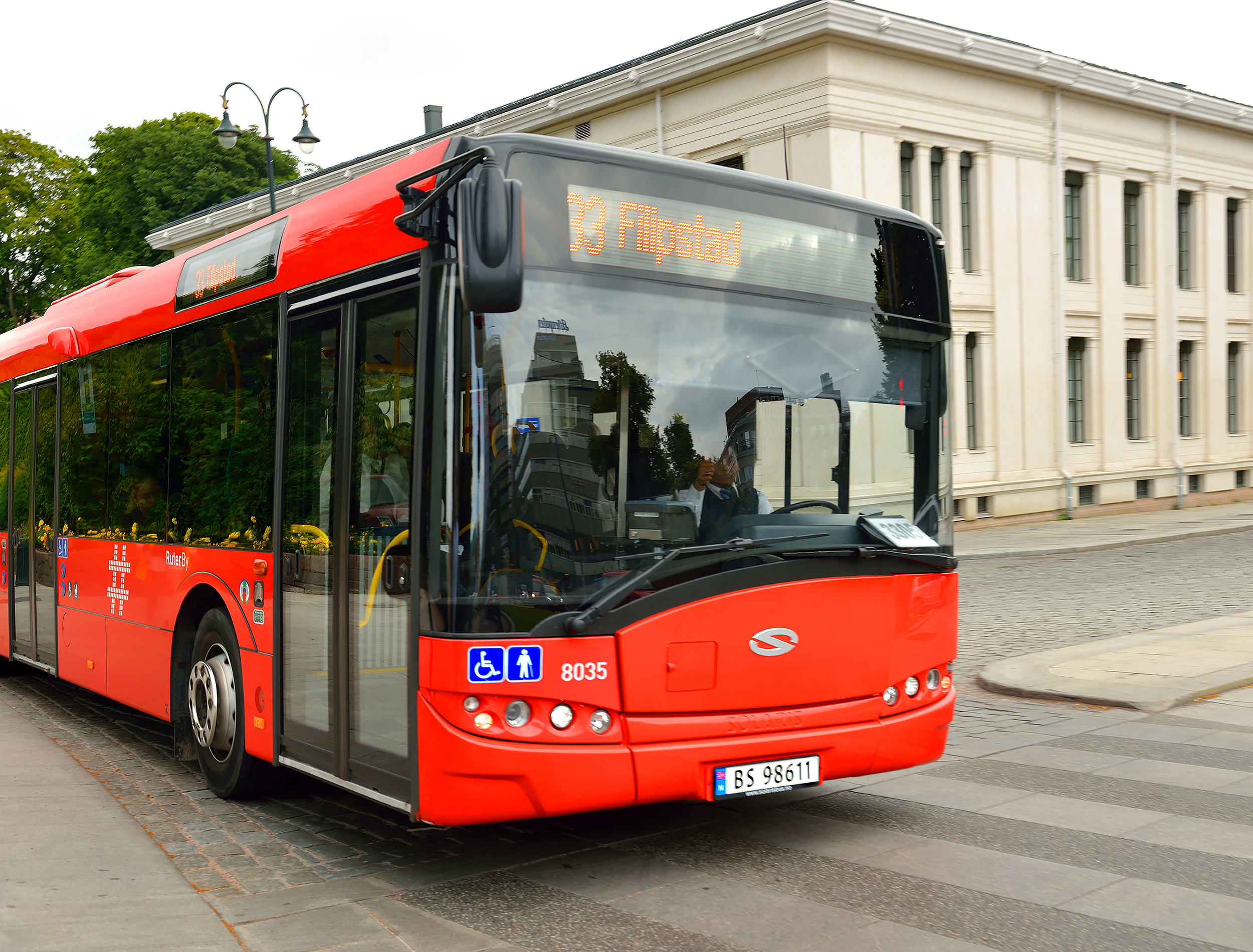
In 2015, Oslo began with an ambitious project to make the inner city car-free within four years. Parking places were transformed into bike lanes, parks, or other types of public space. At the same time, the Norwegian capital began to invest heavily in public transport. Oslo chose a new, centralized bus priority system to improve accessibility for commuters. The new system replaces the old short-range devices. The centralization makes it possible to assess priorities at network level, instead of leaving this decision to each traffic light individually. The system serves both the city and the surrounding region, an area that has some 500 intersections with traffic lights; up to 800 buses are on the road simultaneously every day. An important guiding principle was to make use as much as possible of two ingredients that were already available:
– current bus locations per second on the basis of GPS, already in use for current passenger information, and
– control of all traffic lights for priority requests through the open RSMP protocol.
In the Netherlands, NDOV supplies current public transport data; in Oslo, this is the task of the company Ruter. Ruter combines location data with the timetable to determine any deviation from the schedule. This means the following data is available at every second: the location of every bus, its deviation from the timetable, occupancy rate, and type.
Virtual detection loops
The image below shows how the various systems work together. The buses on the road share their location and occupancy every second with Ruter. Ruter compare this information with the current timetable to determine how long every bus is ahead of, or behind schedule. Ruter’s data flow then goes to Technolution’s Bus Priority System (BPS). The city has configured virtual detection loops for every intersection and every direction in this BPS – these loops exist exclusively in the software, but do have a geographical location. There are loops for pre-notification (pre), near the traffic light (near), at the bus stop (at bus stop) and for termination at the intersection (cancel). Another thing that can be configured is what priority request belongs to what virtual loop. The BPS follows all buses on the map. As soon as a bus ‘hits’ a virtual loop, the system takes a decision on whether to request priority at the next traffic light. The decision depends on occupancy, deviation from the timetable, and requests made by other buses. If the outcome is positive, the system sends a priority request to the traffic light through RSMP.
New network-wide approach using existing hardware
The main innovative aspect of the new priority system in Oslo is its centralized approach across the entire traffic network. But another element is that the system works fully with existing hardware in buses and traffic lights. The BPS system links available systems in a smart way to request priorities.
Experience with the BPS shows that Oslo now has greater control over bus priorities. The city can easily adapt these to respond to temporary changes, such as road works or events.
2. Sweden – Priority for public transport and emergence vehicles
Technolution built on the BPS system in Oslo for the NordicWay3 project in Sweden. In this project, we examined whether existing technology in vehicles (buses, fire brigade, and ambulances) and smart traffic lights could be combined with standardized C-ITS messages, so as to set up a central BPS system. It worked!
The technical set-up of NordicWay3 consists of five elements:
- the standardized C-ITS Interchange Node, which looks after the exchange of C-ITS messages between all parties, including priority requests (SRM messages);
- Trafiklab, which supplies real-time locations for all buses in Sweden (in this case for the Stockholm and Uppsala regions);
- Technolution’s SRM generator, which generates priority requests (SRM) to the Interchange Node on the basis of the locations of buses and virtual loops;
- Evam, which generates SRM messages to the Interchange Node on the basis of real-time locations of emergency services;
- Technolution’s BPS system, which receives the SRM messages and decides what priority requests are sent to the RSMP traffic lights.
An elegant solution
In this elegant solution, the BPS system functions as a ‘translator’ of C-ITS messages. The BPS transmits the priority requests to the traffic lights, so that there is no need for them to be C-ITS compliant. This also means that older traffic lights in Stockholm and Uppsala can be included in the C-ITS ecosystem. The result is a scalable solution that accepts priority requests from parties such as Evam (emergency services). The BPS system thus operates as a priority broker that assesses the requests at network level.
From Scandinavia to the Netherlands
The two Scandinavian projects show how the integration of smart software solutions with existing legacy systems can lead to progress in thinking about priority systems. For Oslo, the advantage is that it has a modern, centralized system that cooperates with its 500 existing traffic lights. This made the system easier to realize and represented a considerable cost reduction. NordicWay3 in Sweden shows that C-ITS standards, too, can be integrated with legacy systems. This successfully facilitates the use of existing, older infrastructure for traffic light prioritization, not only for public transport but also for emergency services and other parties on the road.
If we look at the Dutch situation, this approach could be translated into pragmatic solutions with real-time data from the NDOV and integration with IVERA traffic lights. These could serve as valuable, cost-saving addition or replacement of KAR systems, alongside continued roll-out of iTLC solutions.