Dangerous traffic location or not?
Published on Verkeerskunde.nl
When is a traffic location unsafe? Sometimes the answer is obvious. For example, when crashes occur regularly. Usually, however, this question cannot be answered so easily. Municipalities often hear from residents who experience a location as unsafe. Parents, for example, may have encountered dangerous situations at an intersection near their child’s elementary school. How can subjective experiences be substantiated with objective information? New technology can help collect reliable traffic data quickly.v
The value of near misses
A major challenge for municipalities is obtaining reliable data about the safety of traffic locations. Sometimes information is available about incidents at a particular location, such as police reports of crashes. This information is useful, but often limited, as many crashes are not reported to the police. Near misses are an even richer source of information. If we can observe, analyze, and record near misses at a location, we have extremely valuable information about the safety of that location.
Bringing near misses clearly into view
Until recently, near misses largely went unnoticed. They could only be identified by observing locations for long periods, which in many cases is simply not practical. New technology is now changing this.
The FlowCube traffic sensor uses AI to distinguish between different modes of traffic. It recognizes pedestrians, cyclists, passenger cars, trucks, buses, trams, and more. It also records the speed and direction of each road user. A dedicated algorithm combines this information to automatically detect near misses and capture them in anonymized video footage. This not only gives the road authority information about the number of near misses at a location; it also gives them the opportunity to analyze the corresponding footage.
Verifiable data as a basis for policy
Automatically detecting and recording near misses makes it easy to build a reliable picture of traffic at a location. The system can be configured so that the road authority only sees relevant near misses. For example, there is little value in recording two pedestrians who almost bump into each other because they are both momentarily distracted. It is a different matter when the situation involves a cyclist and a pedestrian, or a cyclist and a car. Their relative speeds are also important. All these parameters can be configured in advance.
For example, with a FlowCube sensor at a pedestrian crossing, the road authority receives a notification and corresponding footage for every potentially dangerous situation. Further analysis of the footage provides insight into exactly what happened: did the pedestrian cross against the light? Was the car traveling too fast? This can be seen for every near miss. By analyzing and categorizing recorded near misses in this way, recurring risk situations become apparent. This reveals which situations occur more frequently and which measures could have the greatest impact on traffic safety.
Similarly, even a highly complex intersection can be monitored efficiently using two to four FlowCubes. This quickly reveals whether a location is unsafe. Decisions about potential modifications can then be supported by verifiable data.
Reliable and privacy-safev
Technology company Technolution has gained extensive experience measuring near misses with FlowCubes in the Netherlands, Finland, and the United States. Based on this experience, the system has been carefully calibrated to record near misses with a high degree of reliability.
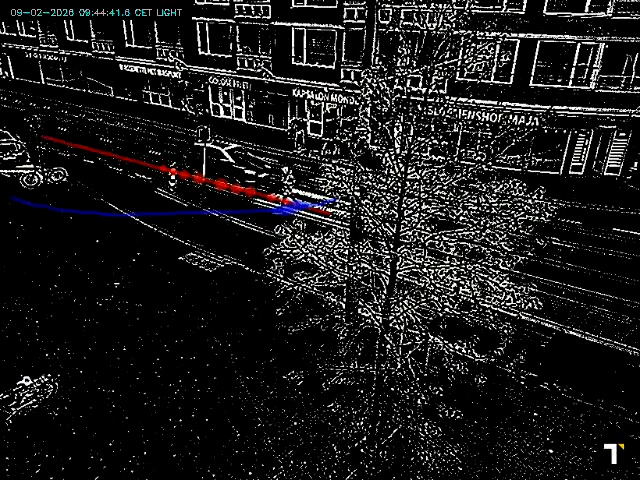
Privacy was an important consideration in the design of the FlowCube. The sensor uses Vision AI: algorithms that recognize and classify individual road users, their mode of transport, direction, and speed. No video footage is stored—the video buffer in the sensor contains only a few dozen seconds of footage. Only when the back-office application detects a near miss is the corresponding footage retrieved from the video buffer, thoroughly anonymized (see Figure 1), and forwarded to the back-office application.
The system was subsequently optimized for practical use based on user feedback. A comprehensive browser-based user interface allows traffic engineers to easily sort and search near misses. The anonymized footage makes it quick to see exactly what happened. The application also provides clear aggregate charts.
The system is relatively compact and can easily be integrated into existing infrastructure. The sensors are unobtrusive, communicate wirelessly, and require only a power connection. Road authorities can monitor a series of locations without major investments. This makes long-term – or even permanent – monitoring of near misses a realistic option.
Before-and-after measurements
Near-miss measurements can also be used to determine whether measures that have been implemented are effective. Suppose a municipality decides, based on these measurements, to modify the traffic infrastructure at a location, for example by installing a speed bump before a pedestrian crossing. The system can then be used for follow-up measurements to determine whether the number of near misses actually decreases.
Near-miss measurements therefore provide municipalities not only with a solid basis for decisions about infrastructure modifications, but also with clear information about the effectiveness of those modifications.
Flexibility for future applications
The FlowCube’s Vision AI technology also offers considerable scope for future applications. Consider long-term traffic studies: how many cars, trucks, or buses pass along a road segment each day, hour, or minute, and how fast are they traveling? What is the ratio of conventional bicycles to fat bikes on a bike path? What are the differences in speed on the bike path?
Another potential application is monitoring unexpected movements in crowds at large events. By modifying the back-office application and retraining the Vision AI, all this information can be collected automatically, anonymously, and reliably.